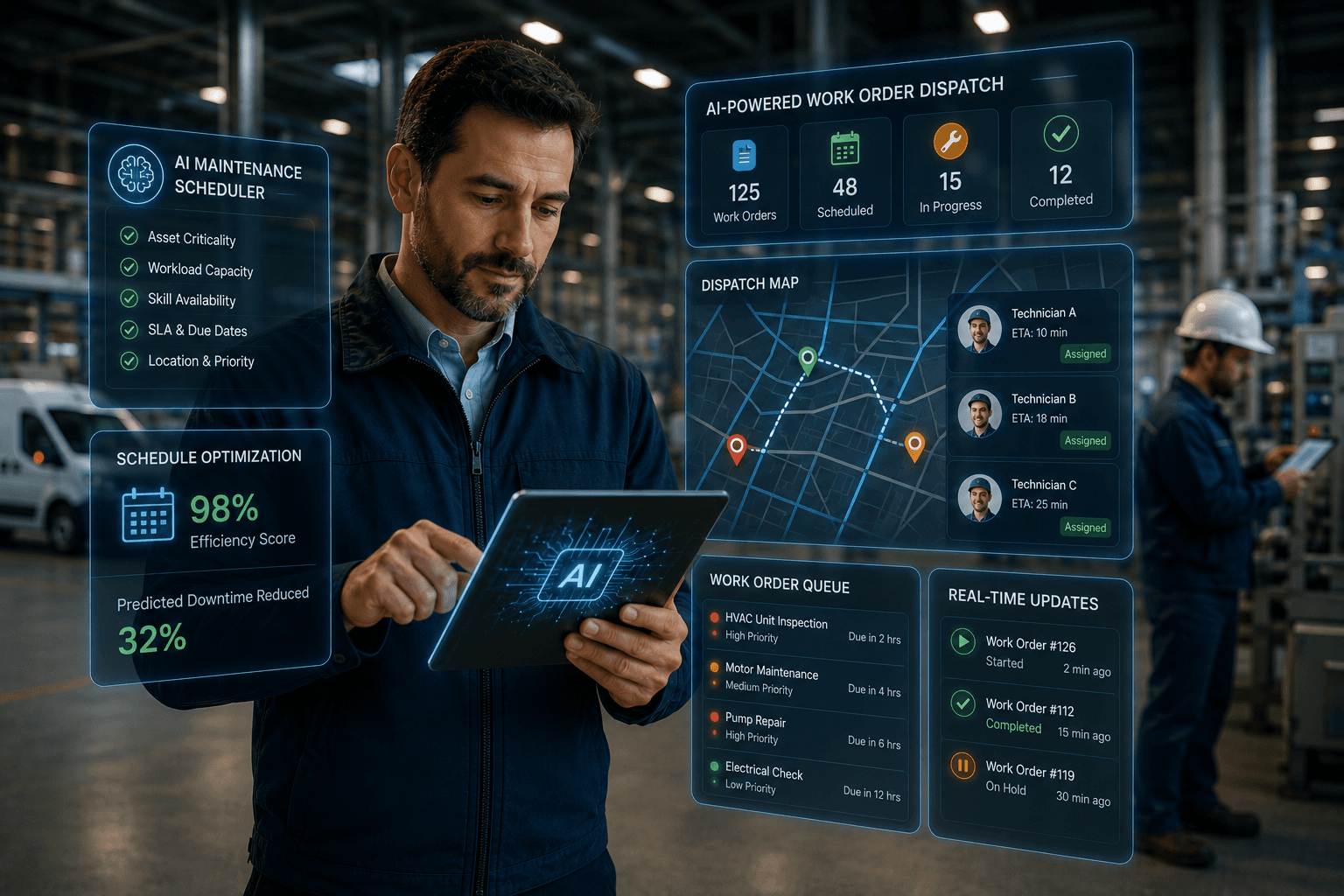
Most facility management platforms promise automation. Few deliver it at the level that actually changes how operations run day to day. The difference between a platform with a few smart features and one with a genuinely autonomous engine is not just a matter of degree — it is a fundamentally different way of thinking about what software is supposed to do.
MIRA — the Management Intelligence and Response Automation engine powering FacilityFlow — is built on the premise that most of the analysis, prioritisation, and decision-making in facility operations should happen automatically, continuously, and without waiting for a manager to log in and trigger something.
This article explains what that actually means in technical terms: how MIRA evaluates asset data, identifies problems before they escalate, and orchestrates work orders across complex multi-site environments without human input.
What MIRA Actually Does Each Night
MIRA runs 34 structured background routines every night across every connected site. These routines are not simple scripts checking whether a field has been filled in. They are parameterised evaluation tasks that compare live telemetry data against dynamic baselines, historical performance records, and contractual SLA parameters simultaneously.
Each routine produces a structured output: a condition score, an anomaly flag if relevant, and a recommended action priority. These outputs feed into the work order engine, the compliance dashboard, and the budget forecasting module — creating a single coherent picture of operational health that updates every 24 hours without anyone having to pull a report.
The routines cover four primary domains: asset condition monitoring, compliance checkpoint verification, resource utilisation analysis, and financial performance tracking. This breadth is deliberate. MIRA is not a predictive maintenance tool with a compliance add-on. It is an integrated intelligence layer designed to give operations managers a complete, auditable view of every dimension of their operation.
How MIRA Evaluates Asset Telemetry
The asset health evaluation process starts with telemetry ingestion. FacilityFlow connects to existing BMS infrastructure, IoT sensor networks, and manual inspection logs through 280-plus REST API endpoints, pulling structured data from disparate systems into a normalised format that MIRA can reason about.
For each asset, MIRA maintains three data profiles: a baseline performance model built from 90-day rolling averages, an anomaly threshold matrix calibrated to asset type and criticality classification, and a failure history record that tracks every maintenance event, repair cost, and downtime episode since commissioning.
During each nightly routine, MIRA compares the current telemetry reading — whether that is a vibration frequency, a power draw measurement, a temperature delta, or an operational runtime figure — against all three profiles simultaneously. If a reading sits within normal bounds relative to seasonal baselines, no action is triggered. If it crosses a configurable anomaly threshold, MIRA raises a condition alert and writes a prioritised work order recommendation to the queue.
The prioritisation logic accounts for asset criticality class (defined as the operational or safety impact of failure), current SLA status for the affected area, available technician capacity, and parts inventory levels. A chiller serving a critical data centre environment with an SLA response window closing in 48 hours will generate a P1 alert. The same anomaly reading on a secondary unit serving a low-occupancy storage area might generate a P3 recommendation with a scheduled inspection date two weeks out.
Compliance Anomaly Detection
Beyond asset health, MIRA runs 47 compliance checkpoints each day. These checkpoints cover three categories: regulatory inspection schedules (gas safety, fire suppression, electrical certification), permit-to-work validity windows (lifting equipment, confined space operations, high-voltage work), and contracted SLA response windows by priority tier.
The compliance detection logic operates on a rules engine that allows operations teams to configure custom escalation thresholds for each checkpoint. A gas safety certificate expiring in 90 days might trigger a routine alert. The same certificate expiring in 14 days triggers an escalation to the compliance manager. At 7 days, it triggers an automatic work order with a P1 designation and a notification to both the site manager and the account director.
This three-tier escalation model is what separates automated compliance monitoring from simple calendar reminders. MIRA does not just flag that something is due. It creates the work order, assigns it to the appropriate engineer based on skills and location data, and tracks completion against the escalation timeline — without any manual intervention.
The Work Order Prioritisation Engine
One of the most operationally significant capabilities of MIRA is its work order prioritisation engine. Most CMMS platforms allow users to manually assign priority levels to work orders. FacilityFlow automates this entirely, using a weighted scoring model that accounts for seven factors: asset criticality classification, time elapsed since fault identification, SLA deadline proximity, tenant impact score, safety risk rating, secondary failure probability, and parts availability.
The weighting for each factor is configurable per client and per site type. A high-traffic retail environment might weight tenant impact score more heavily than a logistics warehouse where asset uptime is the primary driver. An NHS-adjacent healthcare facility might elevate safety risk rating above all other factors automatically.
The result is a prioritised work order queue that reflects actual operational risk — not just whoever logged a ticket most recently or which manager shouted loudest. Research across facility operations has consistently shown that properly automated prioritisation reduces average response times for critical failures by up to 40 percent, simply by ensuring that high-risk items reach the right person immediately rather than sitting in a shared queue.
Real-World Impact: What the Data Shows
Across deployments, facilities using MIRA's autonomous agent framework have seen unplanned breakdown rates fall by an average of 5 percent within the first quarter of operation. This figure understates the actual impact for teams coming from pure reactive operations, where the baseline number of unplanned events is typically much higher.
SLA compliance rates across the portfolio consistently sit above 95 percent — a benchmark that most FM operations struggle to sustain manually across multi-site environments, where the coordination overhead of tracking hundreds of concurrent SLA windows creates genuine operational risk even for experienced teams.
The compliance audit score, measured against the 47 daily checkpoint model, averages above 98 percent across connected sites. In practical terms, this means that when a client or regulator asks for an audit report, the data is already there — clean, timestamped, and structured — without any preparation work from the operations team.
Integration Without Disruption
A common concern when organisations evaluate autonomous AI platforms is the integration burden. Teams that have spent years configuring legacy CMMS systems, BMS installations, and contractor management workflows are understandably cautious about platforms that claim to replace or fundamentally change those systems.
MIRA is designed to layer over existing infrastructure rather than replace it. The 280-plus REST API endpoints handle connections to most common BMS platforms, ERP systems, and contractor management tools without requiring custom development work. For systems that do not have direct API connectivity, FacilityFlow provides structured data import templates that can be integrated with existing reporting workflows.
The average time from contract signature to live MIRA routines running across a new site is under two weeks. That includes data mapping, baseline model initialisation, threshold calibration, and training for the operations team on the dashboard and escalation management interface.
The Strategic Case for Autonomous AI in FM
The argument for autonomous AI in facility management is not primarily about technology. It is about capacity. A senior facilities manager overseeing multiple sites, managing a contractor network, handling client relationships, and responding to operational incidents every day does not have the bandwidth to manually analyse telemetry data for 200 assets, review 47 compliance checkpoints, and reprioritise a 300-item work order backlog — every day.
MIRA does all of that automatically, overnight, and surfaces only the decisions that actually require human judgement. The result is not that the operations team is replaced. It is that the operations team can focus on the work that matters, confident that the analysis layer is handled.
The facilities management organisations pulling ahead in competitive markets are the ones that can demonstrate proactive, data-driven operations to clients during procurement. MIRA provides the analytical backbone that makes that demonstration credible — not with dashboards and reports that have to be prepared, but with live data that reflects the actual state of the operation at any given moment.
