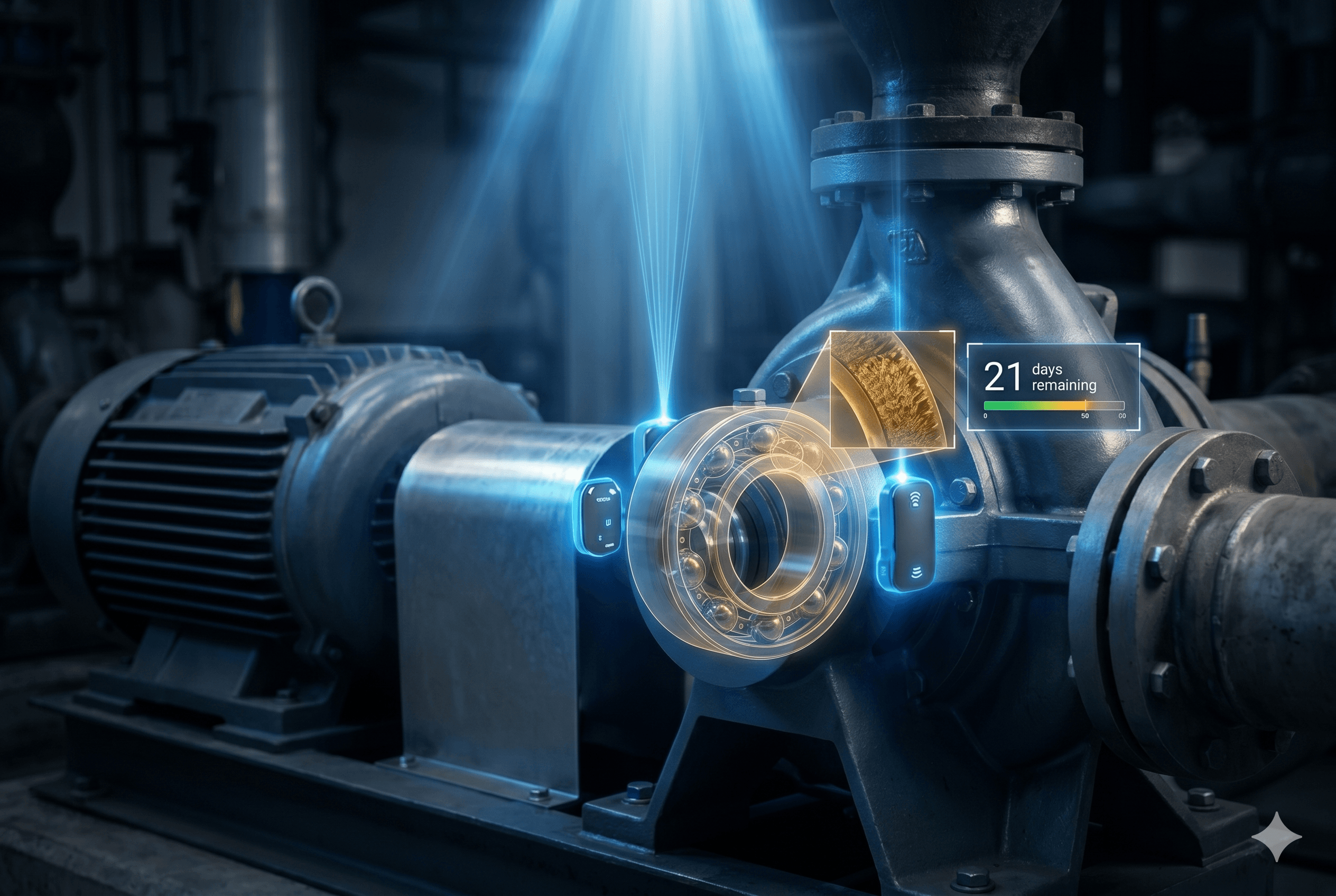
Rotating machinery — pumps, motors, compressors, fans, gearboxes — accounts for a disproportionate share of unplanned maintenance events in most facility portfolios. The physics of rotating components under continuous load creates degradation mechanisms that are well understood, measurable, and highly predictable — which makes the high rate of unexpected failures in these asset classes both frustrating and avoidable.
The mechanisms that lead to rotating machinery failure are not sudden or random. They develop progressively, producing detectable signatures in the machine's vibration profile, temperature distribution, power consumption, and acoustic output weeks or months before they reach the failure threshold. The challenge has historically been detecting those signatures early enough to act — and translating raw measurement data into a maintenance decision that a field engineer can understand and act on.
AI-powered condition monitoring platforms have resolved both challenges. Continuous wireless sensors capture the relevant measurements at sampling rates that would have been prohibitively expensive to achieve even five years ago. Machine learning models trained on failure history data identify degradation patterns in real time and translate them into actionable maintenance recommendations with sufficient lead time to plan an intervention.
The Physics of Rotating Machinery Degradation
Bearing degradation is the most common cause of rotating machinery failure and the degradation mechanism that predictive maintenance technology is best equipped to detect. Ball and roller bearings under load develop fatigue spalling on the raceway surfaces over time — microscopic cracks that grow progressively until they produce surface pitting that changes the vibration signature of the machine.
The vibration signature of bearing degradation is highly specific. Early-stage bearing defects produce characteristic frequency peaks in the vibration spectrum at multiples of the bearing defect frequency — a value calculated from the bearing geometry and rotational speed. These peaks are detectable well before they produce any audible noise or any change in the machine's operational output, which is what makes vibration monitoring so valuable for early bearing fault detection.
Shaft misalignment is the second most common cause of premature rotating machinery failure, and one of the most preventable. Misalignment occurs when the driven shaft and the driving shaft are not collinear — through angular misalignment, parallel offset, or a combination of both. Even small misalignment angles generate significant radial loads on the bearing housings, accelerating fatigue spalling and increasing seal wear simultaneously.
The vibration signature of misalignment is characterised by elevated amplitude at twice the rotational frequency in the radial direction. It is distinguishable from bearing defect signatures through spectral analysis, allowing the condition monitoring system to identify not just that a problem is developing but what type of problem it is — which directly determines the appropriate maintenance response.
Rotor imbalance occurs when the mass distribution of the rotating element is not symmetric about its axis of rotation. This can develop through wear, erosion, product accumulation in pump impellers, or manufacturing variation. Imbalance generates a centrifugal force that rotates with the shaft, producing elevated vibration at the fundamental running speed and increasing bearing loads proportionally to the square of the rotational speed.
How Remaining Useful Life Is Calculated
Remaining useful life (RUL) calculation combines several analytical approaches depending on the available data and the specific degradation mechanism being modelled.
For bearing degradation, the most common approach is a degradation model that maps the measured vibration indicator — typically the root mean square amplitude of the bearing defect frequency band — onto a degradation curve derived from historical failure data for the asset type. The current position on the degradation curve, combined with the observed rate of change in the vibration indicator, produces an estimated time to failure with a confidence interval.
FacilityFlow's Predictive Maintenance Agent uses an ensemble model approach that combines a physics-based degradation model with a machine learning model trained on historical failure data from similar assets in the connected portfolio. The physics-based model ensures predictions remain anchored to known degradation mechanisms even when historical data is limited. The machine learning model captures asset-specific and environment-specific factors that the physics model does not account for, improving accuracy as operational data accumulates.
The RUL estimate is presented to the operations team as a maintenance window recommendation — for example, 'schedule bearing replacement within the next 21 days' — rather than as a raw days-to-failure number. This framing converts the statistical prediction into an operational decision with a clear action and a planning horizon that the scheduling team can work with.
The Vibration Monitoring Infrastructure
Implementing vibration-based RUL monitoring requires sensors positioned at the key measurement points on each machine — typically the bearing housings on the drive end and non-drive end, and the gearbox casing where applicable. For continuously running machinery, wireless MEMS accelerometers have become the standard choice: low-cost, battery-powered, and capable of streaming data at sampling rates sufficient for bearing defect detection.
The FacilityFlow IoT gateway aggregates sensor data from up to 200 measurement points per site, applying edge processing to extract the relevant features from the raw vibration waveform — frequency spectra, bearing defect indicators, overall RMS values — before transmitting structured data to the cloud analytics platform. This edge processing approach significantly reduces data transmission bandwidth requirements and allows the system to operate reliably even on sites with limited network infrastructure.
Temperature and Power Quality Monitoring
Vibration is the primary indicator for bearing and mechanical degradation, but temperature and power quality monitoring provide complementary data that improves RUL prediction accuracy for certain failure modes.
Motor winding insulation degradation produces characteristic changes in the electrical signature of the motor — specifically elevated current harmonics and increased winding resistance measurable through the motor current signature analysis (MCSA) technique. MCSA-based monitoring can detect developing insulation faults and partial discharge events that would not produce any vibration signature until the fault has advanced to a severe state.
Bearing temperature monitoring provides a valuable early warning indicator for lubrication-related issues — elevated bearing temperatures that precede vibration changes by days or weeks in cases where the primary failure mode is lubricant starvation or contamination rather than fatigue spalling. A bearing running 15 degrees Celsius above its typical operating temperature is a candidate for immediate inspection, regardless of its current vibration signature.
Reliability Programme Results
Organisations implementing structured predictive maintenance programmes for rotating machinery see consistent improvements across several key metrics.
Unplanned breakdown rates fall by 30 to 50 percent within the first 12 months of programme operation. This represents the direct detection and prevention of failures that would previously have been discovered only when the machine stopped working. Operations transitioning from purely reactive maintenance achieve reductions towards the upper end of this range; those with an existing preventive maintenance programme see more modest but still significant improvements.
Mean time between failures increases typically by 20 to 40 percent as improved condition information allows maintenance teams to address developing faults at the optimal intervention point. This improvement, compounded over a multi-year asset life, translates directly into deferred replacement costs and reduced total lifecycle spend.
Mean time to repair also decreases because planned interventions based on condition monitoring findings can be prepared in advance. The parts are on the shelf. The specialist tools are ready. The engineer has reviewed the job details before arriving on site. A bearing replacement that might take four hours as a reactive emergency can be completed in 90 minutes as a planned intervention — with better quality outcomes because the engineer is not working under time pressure.
Making the Business Case
For a facilities manager building the case for condition monitoring investment, the financial model is straightforward. A single bearing failure on a critical pump — requiring emergency engineer callout, expedited parts sourcing, and process downtime — typically costs £4,000 to £12,000 depending on asset criticality and contractor premium rates. A planned bearing replacement on the same pump, based on condition monitoring indication, costs £400 to £800.
The basic wireless vibration monitoring installation for a single pump train costs £800 to £1,500 including the first year of platform subscription. If the monitoring prevents a single reactive failure event in the first 12 months — which for any actively running critical asset is highly probable — the investment pays back within the first year. For a portfolio of 20 monitored machines, the economics become compelling very quickly.
